





2025 Wrapped: Scaling to $1B+ With Precision — and What’s Next
Published Updated

Srikanth Narayan
Founder and CEO

Christopher Lange
Head of Investments
2025 was a meaningful year for Cache.
Not because of a single launch or milestone, but because it marked a clear evolution in our journey as a company. We grew from a young startup showing signs of product–market fit into a more mature business scaling its product consistently.
There was a lot of sweat behind that transition. A small team did the work of one several times its size. And it showed.
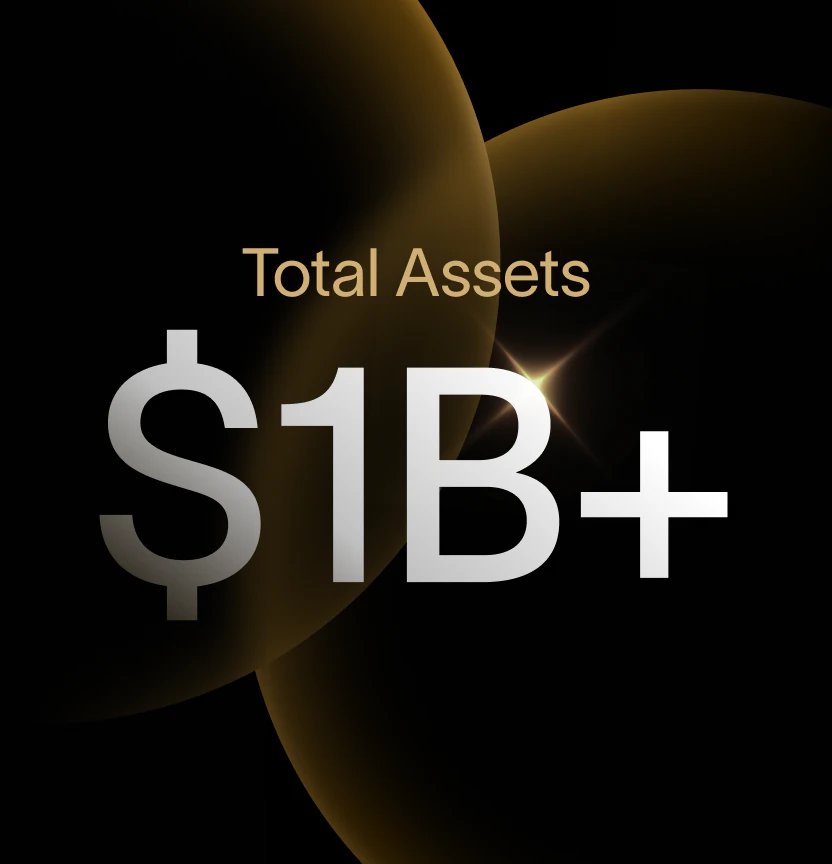
We started the year at $290M in assets. We ended it north of $1B in assets.

Source: Wealthfront
That kind of growth only matters if it’s earned the right way. What I’m most proud of is that we scaled with discipline. We could have grown faster. Instead, we stayed focused on making sure the product delivered on its promise.
As we scaled, portfolios didn’t drift from their assigned benchmarks. Tracking generally improved.
Scaling an Exchange Fund, the Hard Way
Exchange funds aren’t easy to build or scale. That’s why there are so few of them.
They’re assembled one contribution at a time, from individuals contributing their stocks, at different moments and under different market conditions. Historically, that complexity favored large incumbents and discouraged new entrants from even attempting the journey.
In 2025, we showed that the category doesn’t have to be a duopoly.
As Cache grew nearly 4× over the year, our exchange funds remained closely aligned with their benchmarks. In fact, alignment improved as portfolios matured.
The Numbers
These results reflect our Flagship Funds*, which today hold the majority of assets on the platform.
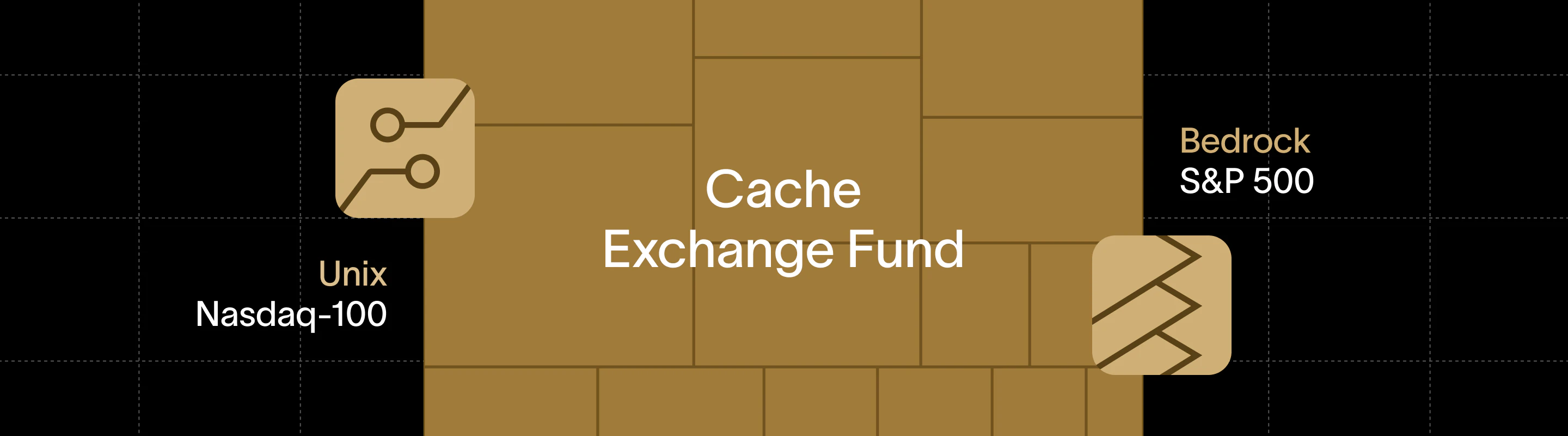
UNIX (Nasdaq-100 Benchmark)
Unix launched August 2024, and has achieved a correlation to Nasdaq-100 of 0.99.
In 2025, it returned 21.65% after fees and expenses (vs. 21.02% for the Nasdaq-100).
Bedrock (S&P 500 Benchmark)
Bedrock launched on July 16th, 2025, and has achieved a correlation to S&P 500 of 0.98.
Since it launch, Bedrock has returned 10.47% after fees and expenses (vs. 9.90% for the S&P 500).

Across both funds, sector exposures stayed close to benchmark weights. Beta and risk characteristics behaved as designed. As assets grew, tracking tightened.
That outcome reflects years of work on intake discipline, portfolio construction, and systems built from first principles specifically for exchange funds.
Big Moments That Mattered
2025 also included a few step-function moments for the platform.
We launched Bedrock, benchmarked to the S&P 500, expanding Cache beyond growth-heavy portfolios to broad-market diversification.
We introduced Index Sync, which aligns portfolios to their benchmarks by holding broad-market ETF shares alongside contributed stocks. It’s now a core part of how we manage drift, fill sector gaps, and scale responsibly.
We ran two major closes using this architecture, including our Fall Aperture, which became the largest close in Cache’s history on December 3rd.
And yes, we wrapped the year with Cache on the big screen in Times Square. A surreal moment, and a reminder of how far the platform has come in a short time.

A Product People Want to Talk About
One of the most telling signals this year didn’t come from performance data.
Many new clients told us they heard about Cache from a friend or colleague.
That doesn’t happen because of marketing. It happens when a product solves a real problem cleanly enough that people are willing to attach their name to it. When people find a solution that delivers value as promised and presents the trade-offs transparently, they talk.
What’s Next
We’re entering 2026 with momentum and a full product roadmap.
Our Winter Aperture is now open, with a coordinated close across all three funds on March 11. Our newest fund, Mosaic, benchmarked to S&P 500 Growth, will launch that day as well.
👉 See if you qualify for the upcoming fund close.
We’re also working to roll out several new capabilities driven directly by client needs:
- Upgraded Collar Advance, with rates as low as 3.7% in annual borrowing costs
- Cash contributions to Exchange Funds, adding flexibility and seeking to further improve portfolio alignment
- Borrowing against Exchange Fund shares, a frequent request that we are working on with multiple banks
And we have more in the works that we’re not ready to announce just yet.
Closing Thoughts
In 2025, Cache proved that it can scale responsibly and deliver results as designed—even through significant growth and change. That consistency is what enabled investors to engage with confidence.
We want Cache to be the default choice because it holds up under rigorous due diligence. Our clients approach this decision the same way they evaluate any significant financial commitment: they evaluate their options, pressure-test the trade-offs, and commit knowing the product has earned their trust and respect through the outcomes it has delivered.
To our clients and partners: thank you for trusting us with something deeply personal. And to the team at Cache—scaling to $1B+ with this level of discipline doesn’t happen by accident.
Here’s to 2026. We’re just getting started.


Cache Exchange Funds are alternative investments available only to investors who meet applicable eligibility requirements, including accredited investor or qualified purchaser standards, as applicable. Exchange Funds involve long-term investment risk, limited liquidity, and may carry higher fees than traditional investment products. Exchange Funds may provide tax deferral but do not eliminate the obligation to pay taxes when assets are ultimately sold. Tax outcomes depend on individual circumstances and applicable law, which may change. Investors should consult their own tax advisers regarding potential tax consequences.
As part of portfolio rebalancing, certain Cache Exchange Funds may make indirect investments in exchange-traded funds (ETFs) sponsored by unaffiliated third parties. These ETFs track broad-based securities indices. Index-based exposure is available only in certain qualified purchaser funds. There is no guarantee that any investor’s contributed securities will be included in a rebalance. Broad-based indices are unmanaged, and investments cannot be made directly into an index.
Collar Advance is a strategy that allows customers to borrow against Exchange Fund interests using a fixed-duration loan, typically ranging from two to five years. Interest is embedded in the total transaction cost and expressed as an annualized figure for ease of understanding. Collar Advance relies on fixed-term options contracts that may be difficult to unwind in volatile markets. Investors may incur losses when exiting contracts prematurely, particularly during adverse market conditions. Although Collar Advance may provide certain downside protections, investors may still experience losses if share prices decline over time and may forgo gains above established cap levels. Dividends received on securities pledged under Collar Advance arrangements are not considered qualified dividends and may not receive preferential tax treatment. Cache Securities LLC offers this service in partnership with Fort Point Capital Partners LLC and Uhlmann Price Securities and receives a referral fee. Clients do not incur additional fees for working with Cache Securities LLC.
Any references to correlation, beta, tracking error, or similar metrics are based on historical data and are backward-looking statistical measures provided for informational purposes only. Such measures do not predict future performance.
The Cache Exchange Fund can help.

Make better decisions for managing your large stock positions.
Sign up to receive all our insights and data.