Mark sent you an exclusive invite to invest with Cache.
When you sign up for Cache using Mark's unique referral link, you both get $100,000 managed free for one year.
Got it
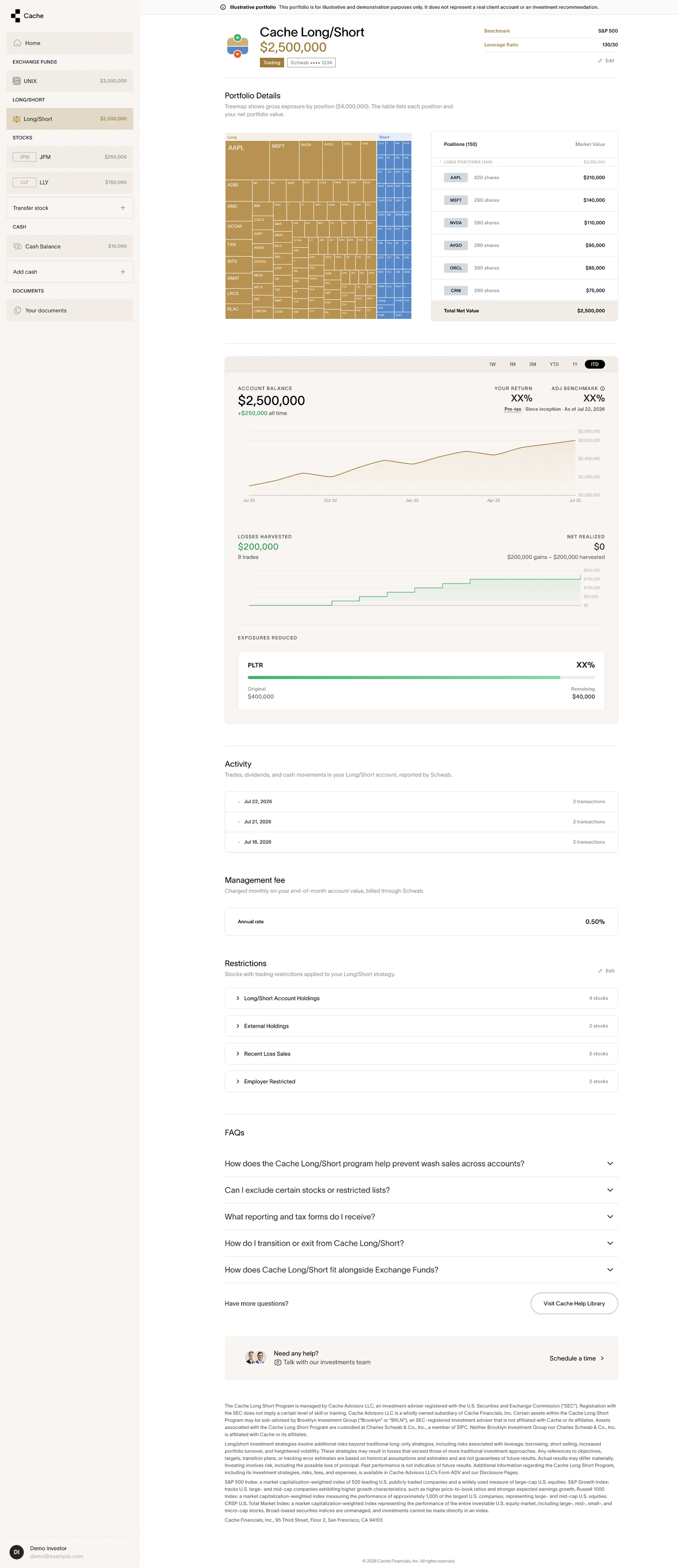
Cache Long/Short

Diversify tax-efficiently, 
on your own timeline

An institutional strategy to help manage taxes as you transition a highly appreciated portfolio.
Schwab Custody
Sophisticated Execution
Easy as 1,2,3
See if you are a fit
Harvest losses across market cycles

Seeks to generate offsets across more market conditions than direct indexing.

Tax-efficiency with flexibility

Maintain tax efficiency while retaining daily liquidity and portfolio flexibility.

Low fees and financing costs

Starting at 0.50% advisory fee and 0.17% financing costs (post-tax).

"One of the most important parts of my decision was trust.
With Cache, I felt I was working with a company that has high integrity and would take good care of my investments."

— Gagan H, VP Engineering
Testimonials are provided by a current Cache investor and may not be representative of the experience of other customers. A conflict of interest exists in that the client is an investor in a Cache investment.The testimonial is no guarantee of future performance or success. The individual was not compensated for this testimonial, and this is not a paid testimonial.
COMMON USE CASES

When to consider a
tax-aware long/short strategy

Diversify concentrated stock, tax-efficiently

Reduce concentration gradually while generating tax offsets, without selling all at once.

Manage your realized capital gains

Offset realized gains from stock sales, rebalancing, or other liquidity events across your taxable portfolio.

Prepare for an upcoming liquidity event

Build potential tax offsets ahead of an IPO or planned diversification, in coordination with your tax advisor.

Position for after-tax outcomes

Use it as a “long-short direct indexing” solution. Manage gains over time, while staying invested in the market.

A better long/short, built with Brooklyn Investment Group

Cache and Brooklyn have partnered to build a long/short solution that’s more accessible and easy-to-use.

About Brooklyn Investment Group
SEC-registered and regulated
Decades of experience
$2.5B+ in SMAs managed
Calculator

See how you could benefit

Overview

How the strategy works

A step-by-step overview of how the long/short tax-loss harvesting strategy is structured and managed over time.

How Tax-Aware Long/Short works

1. Start with your portfolio

You begin with your concentrated stock, plus any other assets you'd like to include — ETFs, mutual funds, or cash. These form the core of your portfolio. The more you contribute, the faster the strategy can work.

2. Add long and short extensions

The size is determined on your risk tolerance. Larger extensions can help to accelerate diversification, but also increase overall risk and tracking error. Smaller ones are intended to take a more gradual approach.

3. Harvest losses as markets move

As markets move in either direction, the long and short extensions generate ongoing opportunities to realize losses. Those losses offset the gains from selling your concentrated stock — so you diversify tax-efficiently over time. This isn't a one-time event. It's a continuous engine.

4. Simplify on your timeline

When you're ready to exit, you can choose to gradually dial back the extensions. What remains is a diversified, long-only portfolio. Unused losses can potentially carry forward to offset future gains from rebalancing, distributions, or liquidity events.

Prev

Next

Extensions Disclosure
1. Add long and short extensions

Your portfolio gains additional long and short exposure through margin borrowing and short sales. The size of these extensions is selected upfront and determines how aggressively the strategy operates.

2. Harvest losses as markets move

As markets move, the long and short extensions create ongoing opportunities to realize losses. Those losses can be used to offset gains as you reduce concentration and build a diversified portfolio over time.

3. Gradually reduce the extensions

When you want to reduce complexity or risk, the extensions can be gradually dialed back. You keep the diversified portfolio, with fewer moving parts.

See if you are a fit
FEATURES

Why investors choose Cache Long/Short

A professional-grade tax-loss harvesting engine for your personal portfolio.

Built on your Schwab account

Your Cache Long/Short portfolio is held at Charles Schwab, in your own name.

Expert investment management

Experienced team at Brooklyn manages trading, factor balancing, and tax-aware execution.

Self serve-onboarding

Open and fund your account entirely online, on your own timeline. Fully digital real-time experience you can manage easily.

Automated monitoring

Built on a sophisticated tax-aware engine that seeks to avoid wash sales against stocks you hold in your portfolio.

Extensions offered

EST. Annual Losses Harvested
8-12%
vs. 3% - 8% for traditional direct indexing
Primary Use Case
Gradual portfolio transition
Leverage Risk Profile
Moderate
Minimum Investment
$500K
Target Benchmarks
S&P 500, Russell 1000, or Total US Stock Market
Annual Advisory Fees
0.50%
Annual Financing Cost
0.28%  Pre-tax
0.17%  Est. Post-tax
Tax Reporting
1099
EST. Annual Losses Harvested
12-18%
vs. 3% - 8% for traditional direct indexing
Primary Use Case
Steady loss harvesting
Leverage Risk Profile
Moderate-High
Minimum Investment
$500K
Target Benchmarks
S&P 500, Russell 1000, or Total US Stock Market
Annual Advisory Fees
0.60%
Annual Financing Cost
0.475%  Pre-tax
0.28%  Est. Post-tax
Tax Reporting
1099
EST. Annual Losses Harvested
15-22%
vs. 3% - 8% for traditional direct indexing
Primary Use Case
Accelerated loss harvesting
Leverage Risk Profile
High
Minimum Investment
$500K
Target Benchmarks
S&P 500, Russell 1000, or Total US Stock Market
Annual Advisory Fees
0.75%
Annual Financing Cost
0.71%  Pre-tax
0.43%  Est. Post-tax
Tax Reporting
1099
EST. Annual Losses Harvested
20-30%
vs. 3% - 8% for traditional direct indexing
Primary Use Case
Aggressive loss harvesting
Leverage Risk Profile
Very High
Minimum Investment
$500K
Target Benchmarks
S&P 500, Russell 1000, or Total US Stock Market
Annual Advisory Fees
1.00%
Annual Financing Cost
0.95%  Pre-tax
0.57%  Est. Post-tax
Tax Reporting
1099
EST. Annual Losses Harvested
24-35%
vs. 3% - 8% for traditional direct indexing
Primary Use Case
Aggressive loss harvesting
Leverage Risk Profile
Very High
Minimum Investment
$500K
Target Benchmarks
S&P 500, Russell 1000, or Total US Stock Market
Annual Advisory Fees
1.10%
Annual Financing Cost
1.18%  Pre-tax
0.71%  Est. Post-tax
Tax Reporting
1099
Important to know
Higher Risk

Extensions utilize margin borrowing and short sales, increasing risk profile, especially during volatile markets.

Performance Variability

Returns may deviate from benchmark performance, especially at higher borrowing levels.

Conditional Benefits

Loss harvesting is not guaranteed, and varies by market conditions.

See if you are a fit
getting started is easy

Self-serve onboarding
and a fully digital experience

Cache Long/Short is designed to help modern investors manage their tax-aware investments with ease.

Design your portfolio and extensions

Choose your goal, select your benchmark and set your extension size (borrowing %). You’ll also go through a risk assessment to ensure you are a fit.

1
Set up your Schwab account

Open your managed Schwab account (held in your name, joint, or trust) and fund the account with your core assets.

2
Harvest and transition gradually

Let the long/short engine work for you. The portfolio runs continuously, losses are harvested systematically, as volatility may create opportunities to realize tax offsets over time.

3
See if you are a fit
MEET THE BKLN TEAM

An active strategy,
managed by an expert team

Guided by decades of experience navigating changing market conditions.

1
Built for concentrated stock
2
$1B+ in assets
3
SEC-Registered Advisor
1
Tax-Aware SMA Specialist
2
$2.5B+ in managed assets
3
SEC-Registered Advisor
Erkko Etula, Ph.D.

CEO & Chief Investment Officer

MD at Goldman Sachs, New York Fed Economist. NYU Adjunct Professor. Harvard, MIT.

Antti Petajisto, Ph.D.

CHIEF EQUITIES STRATEGIST

Former Portfolio Manager at  BlackRock. Professor at Yale and NYU. MIT.

David Wood, Ph.D.

Chief QuantITATIVE Strategist

Quantitative Researcher at hedge funds and Credit Suisse. UChicago.

Shahz Katri

Head of Trading

Quantitative trading at Citadel and Goldman Sachs. Carnegie Mellon.

See if you are a fit
HOW INVESTORS USE CACHE

A complete
diversification toolkit

Access all the tools you need to diversify your concentrated stocks in one place.

Cost basis of your shares

Cache Exchange Fund

For shares with significant embedded gains

Long-term structural diversification
Immediate diversification
Deferral keeps your wealth compounding
7-year holding period
Cache Long/Short

For managing transitions from shares with moderate gains

Ongoing tax management engine
Gradual diversification
Enhanced loss-harvesting
Leverage and short sale risks
Tax-Optimized Sale

For diversifying shares with low embedded gains

Straightforward path, optimized
Immediate liquidity
Sell lots with lowest tax impact
Lowest fees and expenses

"Cache solved a problem I'd been facing for years - how to diversify after over a decade of accumulating my previous company's stock without a massive tax hit. Since my first investment, I've continued to contribute additional funds, and I sleep better now knowing I'm finally diversified using a platform I trust."

Anonymous (Client)

Ex-Engineer, Amazon

“Exchange funds are offered by other firms, but they’re always extremely expensive and not as transparent as I wanted them to be.”

Rajesh Radhakrishnan (Client)

EVP Engineering

"With other exchange funds, I really did not understand what my options were. It was so confusing that I didn’t know what to do.”

Rohit Parchuri (Client)

CISO, SVP Cyber Security at Yext

"Once I made the decision to go with Cache, there’s a sense of relief. I’m out from under such a huge investment in this one company."

Joel Kruggel (Client)

Reverend & Real Estate Exec

“You can’t time the market. Seven years is a long time, but you will get the financial security of having the diversity without the tax bill.”

Jonathan Sorenson (Client)

Director of Engineering

“The biggest benefit for me was peace of mind. I’m still exposed to the market, but no single company dictates my financial future anymore. That alone made it worth it.”

Vinay Perneti (Client)

VP Eng @ Augment Code

“In the last six months, my exchange fund portfolio grew about 25 to 30 percent, while my concentrated position didn’t grow and actually went down slightly. Seeing that made the value of diversification very real for me.”

Gagan Hasteer (Client)

VP Infrastructure Engineering

"Cache brought simplicity and transparency to the exchange fund process that was traditionally complex and opaque. It made diversifying my concentrated portfolio simple."

Kranthi Ravi (Client)

Formerly Sr. Director, ServiceNow

"Cache has built THE PERFECT PRODUCT for tech professionals with concentrated stock positions — and their client service is second to none."
Anonymous (Client)

Former Director and GM, Amazon

"Cache enables investors like our clients to eliminate single stock risk without paying a hefty diversification tax."

Michael Spector (Advisor)

CEO, Adero Partners

"The transparency in pricing and simplicity in design makes sophisticated investing straightforward and user-friendly."
Kintan Brahmbhatt (Client)

CEO and Co-Founder, Olto.com

"It’s a welcome departure from traditional exchange funds. Our clients can diversify concentrated positions and keep exposure to the growth sector."

John Porter (Advisor)

CEO at Three Bell Capital

"Cache provides a simple and accessible approach to diversifying post-IPO stock that many lifelong tech workers never knew existed."

Thomas Chen (Client)

CTO at Supaglue and Ex-Uber Engineer

"Cache made the entire investment process incredibly simple and straightforward. Not only is their product truly amazing, but the exceptional customer service makes them the absolute best in the industry. Their innovative approach sets them far ahead of competitors."

Anonymous (Client)

Ex-Portfolio Manager, BlackRock

"I tried to do an exchange fund before Cache, and it was like trying to join a cult. Little info, little transparency, and little confidence with cost and charges. Cache changed all that!"

JC Puente (Client)

Director at Microsoft

"Cache has put together an experienced, professional team that brings the tax efficient strategies of the ultra-wealthy to the masses."

R Singh (Client)

Ex-Google

"Cache has broadened access to a product that has historically been exclusive, expensive, and unable to accept our client assets. It's a huge addition to our concentrated position playbook."

Eric Franklin, CFP® (Advisor)

Founder at Prospero Wealth and Early Amazon Employee

"Cache provides a great service that just works. Their low-friction delivery of complex financial products made becoming a client an obvious choice."
Peter (Client)

Chief Product Officer

Cache does not pay for testimonials or endorsements

Testimonials provided by clients are from investors in the Cache Exchange Fund and may not be representative of the experiences of other customers. Endorsements are provided by Advisors who utilize Cache for their clients and may not be representative of the knowledge of other advisors. Testimonials or endorsements are no guarantee of future performance or success. No individuals were compensated for sharing their testimonials and endorsements with Cache. A conflict of interest exists in that the individuals have a business relationship with Cache.

FAQs

About Long/Shorts

(X)

  • What is Cache Long/Short?

  • Who is this strategy for (and not for)?

  • When does Cache Long/Short make sense?

  • What’s the main benefit of Cache Long/Short?

  • Is this a hedge fund?

  • How does Cache Long/Short fit alongside Exchange Funds?

How It Works

(X)

  • How does Cache Long/Short work, in simple terms?

  • How is this different from traditional tax-loss harvesting or direct indexing?

  • What kinds of gains can harvested losses offset?

Taxes & Outcomes

(X)

  • Are results guaranteed?

  • How long does it typically take to see tax benefits?

  • What happens if tax laws change?

Risk & Structure

(X)

  • Do I need margin approval?

  • What risks should I understand?

  • Can I lose more than I invest?

Liquidity, Access & Transitions

(X)

  • How liquid is the strategy?

  • How do I transition or exit?

Compliance & Operational Safeguards

(X)

  • How can Cache help me stay compliant with employer trading rules?

  • How does the program help prevent wash sales across accounts?

  • Can I exclude certain stocks or restricted lists?

Trust, Custody & Logistics

(X)

  • Within Cache Long/Short, who does what?

  • What happens if Cache or Brooklyn can't continue operations?

  • What reporting and tax forms do I receive?

Costs & Tradeoffs

(X)

  • What does this strategy cost?

  • How should I think about costs vs. potential tax savings?

  • What are the tradeoffs compared to doing nothing or selling outright?

QUESTION

Category

01/04

What is Cache Long/Short?

Cache Long/Short is a tax-aware investment strategy designed to help you diversify out of concentrated stock positions gradually while seeking to manage the tax consequences.

The strategy builds a portfolio of long and short positions around your existing holdings, configured toward your long-term goals. Long positions that decline and short positions that rise both create potential losses the portfolio manager can harvest deliberately. Those realized losses may then be used to offset taxable gains elsewhere, subject to applicable tax rules. Throughout, your net market exposure is targeted at 100%.

We built this in partnership with Brooklyn Investment Group (BKLN), an SEC-registered advisor with deep experience in institutional tax-aware investing. BKLN manages portfolio construction, trading, and tax-aware execution. Cache brings the strategy to you through a modern, online platform.

The minimum investment is $500K. And your assets are held in a separately managed account at Charles Schwab, in your name.

Who is this strategy for (and not for)?

Cache Long/Short is built for investors who have significant unrealized or ongoing capital gains, a high marginal tax rate that makes tax efficiency materially valuable, a multi-year investment horizon, and comfort with margin, leverage, and portfolio complexity.

It may not be appropriate if you don’t have meaningful taxable gains to offset, are uncomfortable with margin borrowing, want a one-time tax solution rather than an ongoing strategy, or prefer simple, long-only portfolios.

This strategy involves leverage, financing costs, and operational complexity. For the right scenario, those tradeoffs make sense. For others, simpler tools (like direct indexing or a straightforward sale) may be a better fit.

When does Cache Long/Short make sense?

Here’s when investors typically consider this strategy, and what to weigh in each case.

1. Diversify concentrated stock, tax-efficiently

You hold a large, appreciated position and want to reduce concentration risk without a large, immediate tax bill. The right approach depends on your cost basis. For very low basis shares, an exchange fund offers immediate diversification with a simpler structure (though it requires a seven-year holding period). Cache Long/Short may be better suited for medium-basis shares or as a complement to an exchange fund, letting you gradually sell over time while seeking to harvest losses to offset those gains.

Many investors use both: an exchange fund for the portion they can commit long-term, and Long/Short for the rest.

See: Two Paths to Tax-Efficient Diversification

2. Offsetting gains you’ve already realized

You’ve sold stock or have gains from fund distributions, rebalancing, or other activity, and you want to offset that liability within the current tax year. If you act within the same year, the strategy can generate losses that may offset those gains. Excess losses can be carried forward. The amount generated depends on market conditions, leverage level, and portfolio activity. Results vary, and specific outcomes cannot be guaranteed.

3. Preparing for an upcoming taxable event

You have a known event on the horizon, such as an IPO lockup expiring, a secondary sale, a business exit, or a real estate sale, and want to build up losses in advance. The earlier you start, the more losses you may accumulate before the event. If it doesn’t occur or is delayed, unused losses carry forward.

4. Managing ongoing tax drag over time

You don’t have a single large event, but you have recurring gains from RSU vesting, fund distributions, or other investment activity. Traditional tax-loss harvesting can run dry as portfolios fill with appreciated positions. Cache Long/Short seeks to continue generating harvestable losses across different market environments, including rising markets.

This approach tends to work best with a multi-year horizon (15+ years), particularly for estate planning or wealth transfer, where assets may receive a step-up in basis under current tax laws.

Results depend on market conditions and individual circumstances. Consult a tax professional to understand how this fits your situation.

Cache does not provide tax or legal advice. Consult your tax advisor before making decisions based on these scenarios.

What’s the main benefit of Cache Long/Short?

More control over your taxes. The strategy seeks to generate a renewable supply of capital losses you may apply against taxable gains, while keeping your portfolio fully invested.

The key advantage over traditional tax-loss harvesting: in a long-only portfolio, harvestable losses tend to dry up as markets rise and positions appreciate. By adding short positions, the portfolio is designed to seek to produce harvestable losses across a wider range of conditions, including bull markets, because short positions can lose value even when stocks go up.

The strategy doesn’t eliminate taxes. It seeks to defer them, giving you more control over when and how much you pay.

Is this a hedge fund?

No.

Cache Long/Short is a separately managed account held in your name at Schwab. You own the underlying securities directly.

The investment strategy is rigorous, but the structure is intentionally simple and transparent: professional portfolio management delivered through a personal brokerage account.

How does Cache Long/Short fit alongside Exchange Funds?

They solve different parts of the same problem, and they’re often used together.

An exchange fund lets you diversify immediately, without triggering tax, but requires a seven-year holding period. Cache Long/Short may complement that by helping you manage remaining positions more flexibly, seeking to generate tax losses to offset gains as you gradually sell shares, handle fund distributions, or plan for future liquidity events.

You can use both: an exchange fund for the portion you’re comfortable locking up, and Cache Long/Short for the portion you want to work down over time.

How does Cache Long/Short work, in simple terms?

You open a managed account at Schwab. Inside it, Brooklyn Investment Group (BKLN) builds a diversified portfolio of long and short positions around your existing holdings.

The portfolio holds more long exposure than short, keeping your net market exposure close to 100%. The structure creates two sources of harvestable losses: long positions that decline in value, and short positions that rise in value. As markets move, BKLN seeks to realize those losses deliberately and consistently.

The realized losses show up on your tax forms and may be applied against gains from selling stock, fund distributions, or other taxable events. Realization and usability depend on market movements, trading activity, and applicable tax rules.

How is this different from traditional tax-loss harvesting or direct indexing?

Traditional tax-loss harvesting and direct indexing both rely on selling stocks that have declined. That works well early on, but over time, as markets rise, portfolios fill with appreciated positions and harvestable losses become scarce. The strategy gradually stalls.

Some direct indexing providers harvest when rebalancing back to a benchmark, which can extend the runway, but often generates gains as positions are trimmed toward target weights.

Cache Long/Short addresses this by adding short positions. Shorts lose value when stocks rise, so the portfolio may have a source of harvestable losses even in strong bull markets. The strategy seeks to produce harvestable losses whether markets rise, fall, or move sideways, rather than depending primarily on downturns.

What kinds of gains can harvested losses offset?

Capital losses can offset capital gains, subject to IRS rules. In practice, that includes gains from selling concentrated stock, gains from ETFs, mutual funds, or individual stocks, capital gains distributions from funds, and certain gains from taxable liquidity events.

Losses offset gains of the same type first (short-term offsets short-term; long-term offsets long-term). If losses exceed gains of that type, they can offset the other category.

Individual tax outcomes depend on your full tax picture. Cache does not offer tax or legal advice. Coordinate with a tax professional when applying harvested losses.

Are results guaranteed?

No.

The amount of losses generated, and the resulting tax benefit, depend on market conditions, portfolio activity, tax rules, and your individual circumstances. Results vary, and specific tax outcomes cannot be guaranteed.

The objective is to improve after-tax outcomes over time through deliberate management of gains and losses, not to guarantee the elimination of taxes or a fixed level of savings.

How long does it typically take to see tax benefits?

While everyone’s situation is different, investors may see usable losses within the first year. In volatile or rising markets, the short extension can generate losses relatively quickly. In flatter markets, benefits may accrue more gradually.

Cache Long/Short works over multiple years. It’s most effective as an ongoing tax management tool, not a one-time fix.

What happens if tax laws change?

Cache Long/Short relies on broadly established principles: the ability to realize capital losses and use them to offset gains. Changes to tax rates, loss-offset rules, or margin regulations could affect the strategy’s value.

Cache and BKLN monitor regulatory developments and adapt where needed. Consult your tax advisor about how any changes may affect you.

Do I need margin approval?

Yes.

The short extension requires margin approval at Schwab.

Margin introduces additional risk, including the possibility of margin calls during periods of market stress. This is one of the most significant risks of the strategy.

BKLN offers different leverage ratios (such as 130/30, 150/50, or 200/100). Higher leverage may increase loss-harvesting potential but also increases cost and exposure to margin calls and amplified losses. The appropriate level depends on your goals and tolerance for margin-related risk.

Before investing, make sure you understand how margin works and how it could affect your portfolio in different market environments.

What risks should I understand?

Cache Long/Short seeks to improve after-tax outcomes, but it comes with real risks.

Market risk. The portfolio remains exposed to equities. If markets decline, the account can lose value.

Leverage and margin risk. Margin creates long and short positions. During market stress, losses can be magnified and margin calls are possible. BKLN seeks to maintain low leverage and diversified positions to reduce this likelihood, but these measures do not eliminate the risk.

Short exposure risk. Short positions can rise unexpectedly. Positions are diversified across hundreds of stocks and managed systematically, but sharp moves can create short-term losses.

Tracking error. Because the portfolio is actively managed for tax outcomes, returns may differ from the benchmark.

Financing costs. Margin interest and stock-borrow costs reduce returns. These vary with market conditions.

Tax and regulatory risk. Changes in tax law could reduce the strategy’s effectiveness.

All investments carry risk, including loss of principal. Diversification may help manage risk but does not guarantee profit or protect against loss. Review the Form ADV carefully before investing.

Can I lose more than I invest?

Yes.

Because the strategy uses margin and short positions, losses are not capped the way they are in a long-only portfolio.

BKLN caps single-stock active positions, avoids expensive-to-borrow stocks, and runs low levels of active risk relative to the benchmark. These measures reduce, but do not eliminate, the risk of outsized losses. Higher leverage ratios increase both the potential for tax-loss generation and the potential for loss.

This strategy is appropriate only for investors who understand these mechanics and have the financial flexibility to absorb losses beyond their initial investment. Before investing, review Schwab’s margin disclosure statement and the Form ADV carefully.

How liquid is the strategy?

Cache Long/Short is designed to be liquid. Your holdings are publicly traded securities in an SMA at Schwab, not a fund with lockups.

You can request withdrawals at any time. The portfolio is adjusted by selling longs and covering shorts to raise cash while keeping the account within margin requirements. Under normal conditions, this takes a few days.

A few nuances: because the portfolio uses margin, positions need to be unwound in an orderly way, so withdrawals aren’t instant. Large or frequent withdrawals can trigger realized gains or losses and may reduce future harvesting capacity. During extreme market conditions, unwinding may take longer.

If you need cash unexpectedly (home purchase, taxes, an unplanned expense), the process is the same. You retain access to your capital without the lockups of exchange funds or private vehicles.

How do I transition or exit?

Exiting is deliberate and tax-aware, not instantaneous. Transitions ideally occur gradually, which helps avoid triggering a large immediate tax bill and allows previously harvested losses to offset gains as they’re realized.

You decide when to begin. BKLN manages execution by gradually reducing the long/short extension and moving the portfolio toward an unlevered, diversified core. Some investors unwind slowly to spread taxes across multiple years. Others accelerate if outside liquidity (from an IPO, business sale, or other event) gives them flexibility to absorb gains faster.
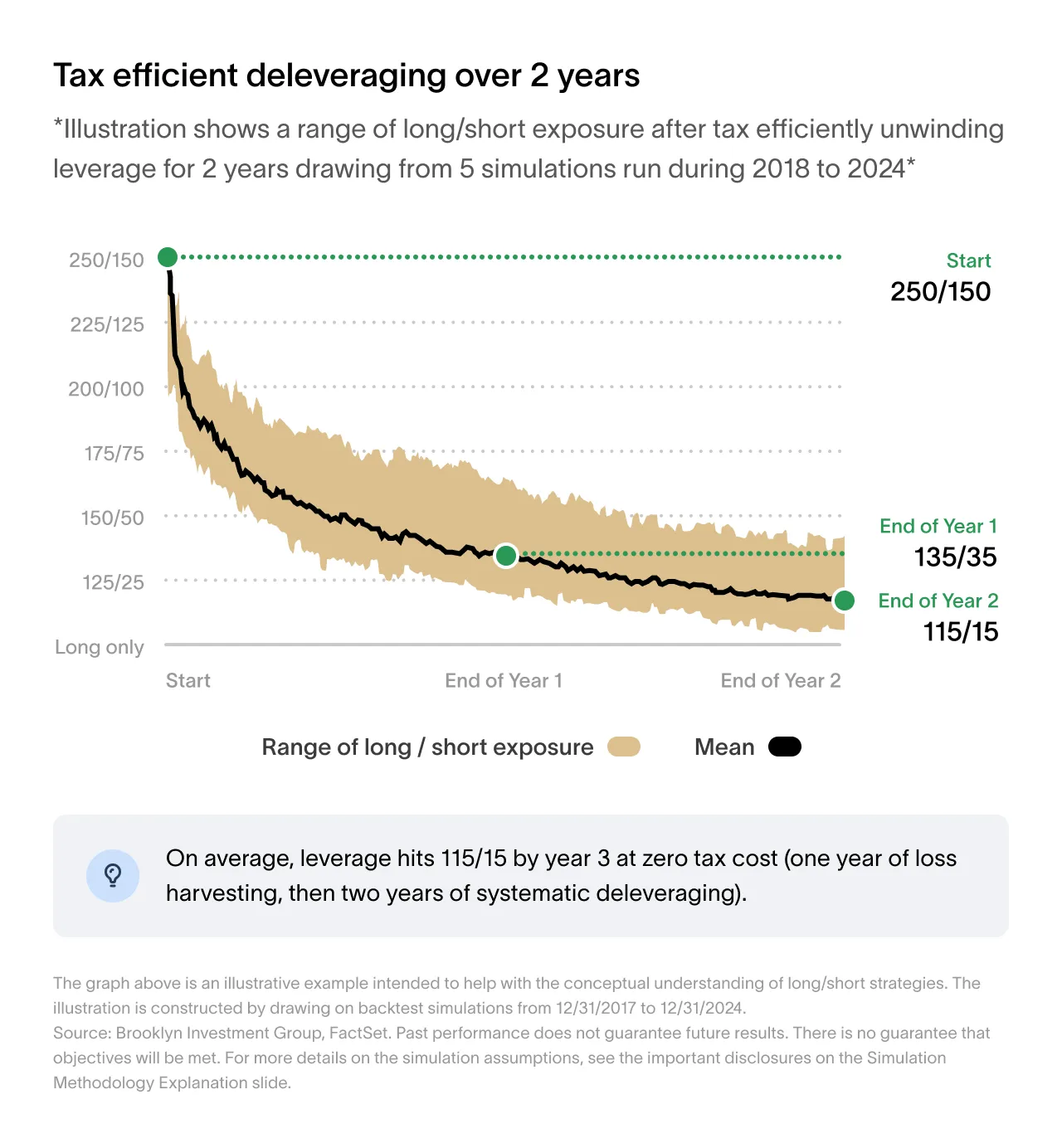
There’s no fixed timeline, but most investors should expect several years, not months. Exiting too quickly compresses the tax benefit. To preserve efficiency, exits should be managed within the strategy. Unwinding positions independently can result in unintended gain realization.

Tax outcomes vary by individual circumstances and market conditions. Consult your tax advisor when planning an exit.

How can Cache help me stay compliant with employer trading rules?

You can exclude restricted stocks from trading and provide outside positions so the strategy manages around them, reducing the risk of accidental wash sales or policy violations.

How does the program help prevent wash sales across accounts?

Cache Long/Short manages wash-sale risk at the household level, not just inside a single account.

When you provide account information to Cache, it’s transmitted to Brooklyn Investment Group (BKLN), whose system monitors trading activity and applies automated controls to reduce the likelihood of disallowed losses. Restricted or employer-related securities can be excluded, and loss-realizing trades are coordinated to avoid repurchasing substantially identical securities within the wash-sale window.

This doesn’t eliminate wash-sale risk entirely, especially when external accounts or discretionary trades are involved, but it significantly reduces accidental violations. If your outside holdings change, let us know so they can be factored in.

A wash sale occurs when a position (or substantially similar position) is bought and sold within a 61-day window: 30 days before the sale, the day of the sale, and 30 days after. The rule applies across all accounts the investor owns, including IRAs, Roth IRAs, and accounts owned by a spouse.

Can I exclude certain stocks or restricted lists?

Yes.

You can provide a list of restricted securities (due to employer policies, insider status, or personal preference) and those stocks will be excluded from trading, subject to review and approval.

Within Cache Long/Short, who does what?

Three parties are involved, each with a distinct role.

Brooklyn Investment Group (BKLN) manages the portfolio: construction, risk modeling, and day-to-day trading. Cache owns the client experience: onboarding, configuration, education, reporting, and the tax and performance dashboard. Cache also serves as the advisor responsible for overseeing the strategy’s implementation, but does not trade the portfolio. Charles Schwab custodies the account and executes trades. Assets are held in your name.

Cache does not take physical custody of client assets. Schwab serves as the independent custodian.

What happens if Cache or Brooklyn can't continue operations?

Your assets stay at Schwab. Your portfolio is held in an SMA in your name, not commingled with Cache’s or BKLN’s corporate funds.

Trading would stop, but ownership doesn’t change. You could transfer the account, appoint a new advisor, or liquidate positions (subject to normal market and tax considerations). Schwab would continue providing account access, statements, and custody protections.

What reporting and tax forms do I receive?

From Schwab: Regular brokerage statements and annual tax forms (Form 1099-B for realized gains and losses, Form 1099-DIV and 1099-INT if applicable). These are the same forms you’d receive from any taxable brokerage account.

From Cache: In-app visibility into realized short-term and long-term losses, net tax dollars harvested, and ongoing gains and losses as they accrue. This is informational reporting, not a replacement for official tax forms.

Cache does not issue tax forms or provide tax advice. All official tax reporting comes from Schwab. You (or your tax advisor) determine how harvested losses are applied on your return.

What does this strategy cost?

Cache Long/Short has three primary cost components.

Advisory fee: Typically 0.50% annually for a standard 130/30 portfolio. Higher extensions (150/50, 200/100) carry higher fees disclosed in your advisory agreement.

Financing costs: Margin interest on borrowed capital can vary across vendors. For a 130/30 portfolio, while variable, we have seen that a 0.28% financing cost, which we have seen is (or 0.17% after tax deductions) is typical. These scale and increase with the extension and fluctuate with interest rates.

All in costs: Apart from the advisory fee and financing costs you bear (about 0.78% for 130/30), there are also additional costs from borrowing stocks for shorting, and trading costs from a high turnover portfolio.

How should I think about costs vs. potential tax savings?

Don’t compare this to an index fund. The relevant comparison is ongoing costs versus avoided taxes.

If you sell a highly appreciated position outright, you may owe 30%+ in combined taxes immediately. That’s a permanent reduction in invested capital. Cache Long/Short at 130/30 has annual management fees of approximately .8% plus trading costs and other fees. That’s real, but it’s recurring, not a one-time hit.

What are the tradeoffs compared to doing nothing or selling outright?

Holding the concentrated position. No costs or taxes today, but you stay exposed to single-stock risk. Taxes don’t disappear; they’re deferred and grow as the stock appreciates.

Selling outright. Immediate diversification and elimination of single-stock risk. But a large, one-time tax hit (often 30% to 40% of gains), paid immediately and irreversibly.

Using Cache Long/Short. Gradual diversification while staying invested. Potential ability to offset gains with harvested losses over time. Flexibility to adjust pace. The tradeoffs: ongoing costs, added complexity (including leverage and short exposure), tax benefits that accrue over time rather than immediately, and a required multi-year horizon.

There’s no perfect answer. The choice depends on which cost you’re most willing to accept.

Now that you’ve made it this far

See if you are a fit

The annual advisory fee of 0.50% applies to the 130/30 model. Estimated financing costs associated with margin and short exposure are approximately 0.28% annually pre-tax and 0.17% post-tax under stated assumptions. Actual financing costs will vary. Models using higher leverage incur higher advisory fees and generally higher financing costs. Additional expenses, including trading costs and custodial charges, are described in your Investment Management Agreement and applicable custodial documentation.

After-tax financing costs assume 31% federal and 9% effective California rates; actual outcomes vary, and more details on tax assumptions are provided in the calculator disclosure.

Brooklyn investment Group is an SEC Registered Investment Advisor, and Assets under Management refer to total advisory assets as of 12/31/25. Registration does not imply a particular level of experience, and values are not updated.

The Tax-Aware Long-Short strategy uses long and short equity positions and an “extension” component, which refers to the use of margin to increase gross exposure above net account value. The target size of any such extension is established at the outset of the strategy and affects the portfolio's overall risk characteristics. Margin borrowing requires custodian approval, is not available to all investors, and is subject to ongoing eligibility and maintenance requirements.

Extensions involve leverage, which increases volatility and may increase both potential gains and potential losses, potentially resulting in losses that exceed the initial investment. Market volatility, asset value changes, or regulatory margin requirements may result in margin calls, forced liquidation of positions, or other adverse outcomes. The strategy also incorporates tax-aware techniques, including tax-loss harvesting, subject to IRS rules and individual circumstances.

Estimated losses harvested are based on hypothetical projections generated by the Tax Loss Harvesting Calculator based on historical market simulations and are not guaranteed. Actual losses harvested will vary and may be materially different. Tax outcomes depend on market conditions, realized gains, individual tax circumstances, IRS rules (including wash sale limitations), and transactions in external accounts.

For comparison, traditional direct indexing strategies have commonly reported estimated annual tax loss harvesting ranges of approximately 3–8% annually, typically up to approximately 30% of the initial amount invested. Such comparisons are provided for illustrative purposes only and are not guarantees of future results. While Long Short Investing is designed to continue to generate taxable losses, losses harvested may decline over time.

Equity strategies that use leverage involve increased risk and may result in significant losses. The long-short risk profile shown is illustrative only and provided solely for general comparison to other long-short strategies. Long-short strategies have higher risk than traditional long-only equity profiles.

Participation in the program requires a minimum initial investment of $500,000. Investors must maintain a minimum ongoing account balance of $300,000 to remain eligible.

Eligibility requirements are subject to change, and additional terms and conditions may apply. Please review the applicable offering materials for complete details.

The S&P 500® Index measures approximately 500 large-cap U.S. companies. The Russell 1000® Index measures approximately 1,000 of the largest publicly traded U.S. companies. The Total US Stock Market Index is benchmarked to the CRSP U.S. Total Market Index represents the broad U.S. equity market, including large-, mid-, small-, and micro-cap stocks, and is maintained by the Center for Research in Security Prices (CRSP) at the University of Chicago. Indices are unmanaged, assume reinvestment of dividends, do not reflect fees or expenses, and cannot be invested in directly.

Annual advisory fees apply only to the managed portfolio and do not include expenses related to trading, financing, borrowing stocks, or other costs.

Refer to your investment agreement for a full breakdown of the costs.

Estimated Financing Costs are listed below by model and assume after-tax financing costs assume 31% federal and 9% effective California rates; actual outcomes vary, and more details on tax assumptions are provided in the calculator disclosure.. Actual outcomes may vary based on an investor’s tax circumstances, state of residence, market conditions, investment horizon, and changes in tax law.

0:00