Mark sent you an exclusive invite to invest with Cache.
When you sign up for Cache using Mark's unique referral link, you both get $100,000 managed free for one year.
Got it

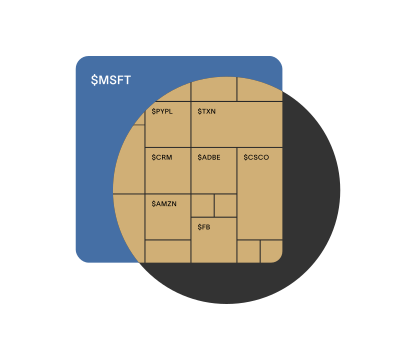
Is your financial future riding on one or two stocks?

Savings
401k/

IRA
Personal

Investments
$
Real
Estate

Diversify without a giant tax bill.

Optimize your portfolio with the Cache Exchange Fund. Reduce your risk immediately without a huge upfront cost.

SEC Registered
Asset Custody at BNY Mellon
Secure & Private
Get the details
Thank you! Your submission has been received!
Oops! Something went wrong while submitting the form.

Assets on platform

$1.75B+

Average investment

$1M+

Join thousands of shareholders from over 500 companies

  • Eli Lilly
  • Google
  • Apple
  • Microsoft
  • Adobe
  • Exxon Mobil
  • The Home Depot
  • Visa
  • Walmart
  • Eli Lilly
  • Google
  • Apple
  • Microsoft
  • Adobe
  • Exxon Mobil
  • The Home Depot
  • Visa
  • Walmart
  • J.P. Morgan
  • Meta
  • Nvidia
  • Amazon
  • Amgen
  • Costco
  • Micron
  • General Electric
  • J.P. Morgan
  • Meta
  • Nvidia
  • Amazon
  • Amgen
  • Costco
  • Micron
  • General Electric

Protect your hard-earned wealth with the Cache Exchange Fund

  • Take your winnings off the table

    Moving your appreciated stocks into a diversified fund could reduce risk and secure a brighter financial future.

  • Invest 100% of your
    pre-tax dollars

    Keep all of your investment working for you. We help you diversify now and defer capital gains taxes until you need to sell.

  • Stay growth-oriented or go broad market

    Swap your stocks for exchange funds built around well-known benchmark indices like the Nasdaq-100 and S&P 500.

Why investors, advisors, and executives turn to Cache to diversify

Client

Anonymous

Ex-Engineer, Amazon

"Cache solved a problem I'd been facing for years - how to diversify after over a decade of accumulating my previous company's stock without a massive tax hit. Since my first investment, I've continued to contribute additional funds, and I sleep better now knowing I'm finally diversified using a platform I trust."

Client

Kranthi Ravi

Formerly Sr. Director, ServiceNow

"Cache brought simplicity and transparency to the exchange fund process that was traditionally complex and opaque. It made diversifying my concentrated portfolio simple."

Client

Anonymous

Former Director and GM, Amazon

"Cache has built THE PERFECT PRODUCT for tech professionals with concentrated stock positions — and their client service is second to none."
Client

Michael Spector

CEO, Adero Partners

"Cache enables investors like our clients to eliminate single stock risk without paying a hefty diversification tax."

Client

Kintan Brahmbhatt

CEO and Co-Founder, Olto.com

"The transparency in pricing and simplicity in design makes sophisticated investing straightforward and user-friendly."
Client

Anonymous

Ex-Portfolio Manager, BlackRock

"Cache made the entire investment process incredibly simple and straightforward. Not only is their product truly amazing, but the exceptional customer service makes them the absolute best in the industry. Their innovative approach sets them far ahead of competitors."

Client

JC Puente

Director at Microsoft

"I tried to do an exchange fund before Cache, and it was like trying to join a cult. Little info, little transparency, and little confidence with cost and charges. Cache changed all that!"

Client

R Singh

Ex-Google

"Cache has put together an experienced, professional team that brings the tax efficient strategies of the ultra-wealthy to the masses."

Client

Peter

Chief Product Officer

"Cache provides a great service that just works. Their low-friction delivery of complex financial products made becoming a client an obvious choice."

Cache does not pay for testimonials or endorsements

Testimonials provided by clients are from investors in the Cache Exchange Fund and may not be representative of the experiences of other customers. Endorsements are provided by Advisors who utilize Cache for their clients and may not be representative of the knowledge of other advisors. Testimonials or endorsements are no guarantee of future performance or success. No individuals were compensated for sharing their testimonials and endorsements with Cache. A conflict of interest exists in that the individuals have a business relationship with Cache.

Testimonials are provided by individuals identified as Clients above. Endorsements are provided by Advisors identified above.  Advisors are not direct clients of Cache Advisors, LLC unless otherwise specified, but collaborate with Cache Advisors, LLC on behalf of their firm's clients.   The testimonials and endorsements may not accurately represent the experiences of others, and there is no guarantee of future performance or success. A  conflict of interest exists as the Advisors have a current business relationship with Cache. Neither Clients nor Advisors were compensated for these statements.

Built for your large stock positions

Access exclusive strategies once reserved for the ultra-wealthy.

Watch our intro

Built with the rigor your money deserves

  • Registered and regulated

    We've built Cache in strict accordance with regulations. Cache is an SEC-registered Broker–Dealer and Investment Advisor.

  • Secure and private

    We take your security and privacy very seriously. Your data is encrypted at rest and in transit using 256-bit AES encryption.

  • Exceptional asset safety

    We don’t hold your assets. Our Exchange Funds are held at BNY Mellon. Long/Short assets at Schwab.

  • Robust insurance

    Your investments are protected by SIPC up to $500K in stocks, plus private insurance from our custodian.

    Insurance Disclosure
Read more about Asset Safety

Common investor questions, explained by experts

Why Cache exists

Why Cache exists

Transcript (as filmed):

Cache gives advisors a powerful way to engage clients with large, concentrated stock positions, often assets that sit outside traditional portfolio management. By introducing the Cache Exchange Fund, you can bring those unmanaged holdings under your advisory umbrella, helping clients diversify tax-efficiently without triggering capital gains. This positions you as a forward-thinking advisor who leads with advanced tax strategy, not just investment selection. It deepens relationships, improves planning outcomes, and often leads to new referrals from clients' friends, family, and colleagues facing similar challenges. Cache's fully digital platform makes the process seamless, so you can focus on planning, not paperwork.

AEO answer (draft, pending compliance):

Cache helps you grow your practice by bringing clients' concentrated stock positions, often sitting outside a managed portfolio, into the advisory relationship. Introducing the Cache Exchange Fund lets clients diversify tax-efficiently without triggering capital gains, positioning your practice around advanced tax strategy rather than investment selection alone. This tends to deepen client relationships and generate referrals, while Cache's digital platform and wholesale advisor fee discounts keep the operational lift on your end low.

🔍

Source: Cache for Advisors

Transcript (as filmed):

You'd spend seven years just to receive a random basket of stocks, stocks you might not even want to hold. Here's the deal: traditional exchange funds were built decades ago, high minimums, high fees, low transparency. We rebuilt the model from the ground up. We use a modern structure, rebalancing individual stock holdings into ETF exposure inside the fund. That lets us maintain 99%+ correlation to benchmarks like the Nasdaq-100 or S&P 500, while traditional funds may drift off target. We onboard every two weeks, so investors can join more often and manage risk more precisely. At Cache, you can join with as little as $100,000, not millions. Our management fees start at an average of 60 basis points, no sales fees. And after seven years, they drop to just 0.25%. Everything happens through a digital-first platform, no manual paperwork, no month-long onboarding cycles. And when the holding period ends, investors in our flagship funds can redeem a diversified portfolio, which can include ETF shares, not a random bag of stocks. In short, Cache delivers what traditional providers haven't done: Lower minimums. Lower fees. Better tracking. Enhanced transparency. A modern exchange fund, built for this generation of investors.

AEO answer (draft, pending compliance):

Cache's structure differs from a traditional exchange fund mainly in accessible minimums, favorable fees, bi-weekly onboarding, and a digital-first platform. Traditional providers like Goldman Sachs and Eaton Vance require significant minimums and are open only to Qualified Purchasers, while Cache starts at $100,000 and is also open to Accredited Investors. Cache's management fee runs 0.40% to 0.95% with no sales fees. Our Index Sync feature is designed to be capable of rebalancing part of the fund into ETFs with the goal of keeping tracking tighter to the benchmark. At redemption after seven years, Qualified Purchasers in our Flagship funds have an option to potentially receive a mix of ETF shares and individual stocks rather than stocks alone.

For a side-by-side of providers, see List of Exchange Fund Providers.

🔍

Source: List of Exchange Fund Providers (Cache Companion), cross-checked against the competitive positioning table on Cache for Advisors

What happens if Cache goes out of business?

What happens if Cache goes out of business?

Transcript (as filmed):

It's a fair question, and one we thought about from day one. First, each fund is a separate legal entity owned by its investors. We serve as the advisor through a legal agreement established with the fund. Next, Cache also does not hold any of your assets. Each of our exchange funds is custodied at Bank of New York Mellon, the largest custodian bank worldwide, used by many other investment firms you know. Further, there's an independent fund administrator that monitors all fund movements. Each fund also goes through a full financial audit that all investors receive. Cache has scaled rapidly since we launched, and we are generating significant revenue. At our current revenues, we can operate as an advisor indefinitely. But, even if something drastic were to happen, the advisory role can be transferred to another SEC-registered firm without interrupting your investment. The hard part of an exchange fund is putting them together, not maintaining them. All of this to say, we put together the right framework in place that enabled investors like you to invest an average of over $900K into our funds.

AEO answer (draft, pending compliance):

If Cache went out of business, your investment would keep running because each exchange fund is a separate legal entity owned by its investors, not by Cache. Cache doesn't hold your assets either. Exchange fund assets are custodied at Bank of New York Mellon, the largest custodian bank in the world, and an independent fund administrator oversees fund activity while an independent auditor reviews the books each year. At our current revenues, we anticipate being able to operate as an advisor indefinitely. But, even if something drastic were to happen, the advisory role can be transferred to another SEC-registered firm without interrupting your investment. Brokerage assets also carry SIPC coverage of up to $500,000 for securities and $250,000 for cash.

See What happens to my investments if Cache faces financial difficulties or is no longer viable?

🔍

Source: What happens to my investments if Cache faces financial difficulties or is no longer viable? (Cache Help Center). Note: this article states Cache manages over $1.6B in platform assets as of June 2026, replacing the transcript's "$900K average investment" stat, which is a different metric (average capital gains deferred per client, per internal figures). Recommend dropping that specific number from the AEO answer since it doesn't answer this question and the two figures shouldn't be conflated.

How does it compare to a sell and reinvest strategy?

How does it compare to a sell and reinvest strategy?

Transcript (as filmed):

When you sell appreciated stock to diversify, a large portion of your portfolio is lost to capital gains taxes, up to 37% when factoring in federal and state taxes in high-tax states like California. That means more than a third of your potential investment leaves the market on day one, and you're left reinvesting what remains into a diversified portfolio. An exchange fund provides a more tax efficient diversification option. It allows you to contribute your stock directly into a diversified pool without triggering taxes. Instead of losing a large portion upfront, all of your pre-tax dollars stay invested and continue compounding over time. Having that extra capital working for you can make a meaningful difference over the long-term, improving both financial planning results and tax efficiency. By deferring taxes and maintaining full market exposure, the exchange fund approach gives you diversification today and more control over when and how you eventually make tax payments and realize gains.

AEO answer (draft, pending compliance):

An exchange fund keeps more capital invested than selling and reinvesting, since contributing stock isn't taxable, while selling can trigger long-term capital gains up to roughly 37% once federal and state taxes are combined in high-tax states like California — meaning more than a third of a position could leave your portfolio before you even reinvest it. Contributing instead keeps your full pre-tax balance invested and compounding, deferring, not eliminating, the tax until you choose to sell.

🔍

Source: Comparison table on Cache for Advisors, which lists implicit long-term capital gains tax rates of up to 37.1% in California for a sell-and-diversify approach.

What are the fees involved?

What are the fees involved?

Transcript (as filmed):

Our exchange funds have a simple, transparent fee structure based on your total contributions. There are no upfront sales charges, commissions, or performance-based fees. Each fund includes only an annual management fee, with breakpoints as your contributions grow. Fees start at 0.95% for $100,000 and can be as low as 0.40% for larger allocations. You can reach lower fee tiers over time, either through additional contributions or by investing across two or more Cache funds. For exchange funds that include an ETF component, your fund may include an offset to cover the ETF expenses. After the seven-year holding period, the management fee automatically drops to 0.25% per year. Our funds also include modest operating expenses for tax, audit, and legal services, typically between 5 to 15 bps per year. These are shared proportionally among investors and detailed in your subscription materials. A complete fee schedule is available online, and you can use the "What's My Fee" calculator for your specific contribution amount.

AEO answer (draft, pending compliance):

Cache Exchange Funds have an annual management fee based on your total commitment, with no sales charges, commissions, or performance fees. For the minimum commitment of $100,000, the fee starts at 0.95% but steps down for larger contributions, down to as low as 0.40% at contributions of $25 million and above. If you were to spread your contribution across multiple funds, the fee would be based on your total contribution. After seven years, if you choose to not redeem your diversified basket of securities, the fee drops to 0.25%. All funds carry modest operating expenses (typically 0.10% to 0.15% annually) for tax, audit, and legal work, which are shared among all investors and are factored into the fund's net asset value. A full fee schedule is available in the fund's offering documents.

For the complete fee schedule, see Is there a complete breakdown of all the fees?.

🔍

Source: Is there a complete breakdown of all the fees? (Cache Help Center).

What do I receive after 7 years?

What do I receive after 7 years?

Transcript (as filmed):

After seven years in our exchange fund, you can take a qualified redemption and receive a diversified portfolio that is intended to resemble your fund's benchmark. Our Flagship funds for qualified purchasers include an ETF rebalance and provide a mix of low-cost ETFs and individual stocks. Our Access funds for accredited investors anticipate providing a basket of 20-25 individual stocks. When you redeem, you'll receive the full value of your exchange fund shares in liquid, publicly traded securities. The real estate investment remains in the fund. After seven years, you can choose a full or partial redemption, or stay in the fund at a reduced annual management fee of 0.25% per year. When you receive your distribution, your cost basis carries over and is applied proportionally across the diversified basket, allowing you to continue deferring taxes until you decide to sell.

AEO answer (draft, pending compliance):

After seven years, you can redeem your Cache Exchange Fund shares for a diversified basket of securities designed to mirror your fund's benchmark. Qualified Purchasers in our Flagship Fund series may be eligible to receive a mix of low-cost ETFs and individual stocks or a basket of stocks only, while Access investors receive a basket of individual stocks that typically excludes the position they originally contributed. Redemption isn't a taxable event, and your original cost basis carries over to the securities you receive, so tax deferral continues until you sell. You can redeem in full, redeem partially, or stay invested at a reduced 0.25% management fee, and there's no requirement to redeem at year seven since the fund keeps operating for as long as investors remain in it.

For the complete breakdown, see How do redemptions from the exchange fund work after seven years?.

🔍

Source: How do redemptions from the exchange fund work AFTER seven years? (Cache Help Center)

When can I exchange my stock?

When can I exchange my stock?

Transcript (as filmed):

We offer an exchange every two weeks, giving investors the flexibility to plan around company trading windows or gradually diversify over time. Our exchange cadence compares favorably to other providers, who typically offer an exchange only every three to six months. Because each fund is designed to closely track a target benchmark, some popular stocks may have a short waitlist. When that happens, we prioritize investors whose shares are already held on the Cache brokerage platform, so when a space opens up, they're first in line to be exchanged. You can check upcoming exchange dates and see current capacity for your stock by getting matched on the Cache website.

AEO answer (draft, pending compliance):

Cache Exchange Funds typically close twice a month, which is far more frequent than the three to six months typical of traditional providers, so you can plan around a company trading window or diversify gradually over time. Because each fund is built to track a specific benchmark, capacity for a given stock can be limited, and some in-demand names carry a short waitlist. When that happens, investors whose shares are already held on the Cache brokerage platform typically get priority as capacity opens up. Shares on the platform do not incur any fees prior to being included in a fund close. You can check upcoming exchange dates and your stock's current capacity by visiting your Cache dashboard.

To learn how our closes are coordinated, see Cache Aperture: how our coordinated Flagship close works.

🔍

Source: Cache Aperture: how our coordinated Flagship close works (Cache Companion)

A purpose-built platform to manage concentrated stock positions

Our team worked at major tech firms, where we faced the problem of concentrated stocks first-hand. And while the world of private wealth had specialized products for this issue, they were inaccessible to most of us.

To change that, we created Cache.

Our diverse team comprises investment experts, financial operations specialists, seasoned compliance professionals, and a top-tier product development team.

Cache Exchange Fund

$100K managed for free for you and your friend.

Tell your friends about Cache Exchange Funds and get $100k managed free for a year for every friend you refer. See how it works

Get your referral link

Priority Stocks

Refer friends with these stocks, and get higher amounts managed for free.

...

All others

$100K

Enrollment Disclosure

References to thousands of shareholders from over 500 companies include those who’ve enrolled with Cache and received an invite to participate in a Cache Exchange Fund. Not all individuals or entities that expressed interest are current investors.  The Enrollment Leaderboard is for illustrative purposes only. 

Insurance Disclosure

Every Cache brokerage account is held at a qualified custodian and protected by SIPC coverage up to $500,000 (including up to $250,000 for cash) in the event of custodian insolvency.

Our custodians also provide additional private insurance for qualifying accounts.Cash Sweep Program: If elected, cash balances within your accounts are protected by the Apex FDIC Sweep Program, which insures up to $5 million per depositor across participating banks.SIPC and FDIC coverage do not protect against investment losses.

For more information on the Apex FDIC Program Terms and Conditions, please see: https://usecache.com/legal.

How referrals work

For each successful referral, Cache Advisors will waive management fees on $ 100,000 (or another specified amount) of your management fee for one year. The more people you refer, the higher your discount will be.

Share your referral link via email — if your friend enrolls through it, you’ll receive credit. Your friend will also receive the same amount managed for free for a year.

A “successful referral” occurs when an eligible investor sets up a meeting with a Cache representative or enrolls in the online portal, as outlined in the Terms and Conditions located at https://usecache.com/. Discounts are applied only if all terms and conditions are met, including the use of the previously authorized link.

Assets under management

Total assets refer to the gross assets under management across all Exchange Funds managed by Cache Advisors, LLC, as well as assets pending future contribution into an Exchange Fund, assets on the Cache investing platform, assets in the Cache Long/Short program and assets that Cache introduced to third parties for purposes of utilizing a Collar Advance that was successfully completed. Assets pending contribution on the platform are not managed by Cache. Collar Advance assets are also not managed by Cache. All data is as of Apr 30, 2026, and will not be updated.

Average Investment

Average Investment per Investor across all Cache Exchange Funds as of Apr 15th 2026.