





Introducing Technocortex: an exchange fund for the AI economy
Published Updated

Srikanth Narayan
Founder and CEO
We believe that AI is the largest technology shift of our lifetimes. Within a few years, it has changed how digital products are built, how scientific discovery happens and how businesses operate, and it's reshaping who will hold the advantage in the decades ahead. Building it takes compute, models, data and talent at a scale no technology has needed before, and the largest technology companies are spending hundreds of billions of dollars a year on its development.¹
Many of our investors hold a stake in this future through one company, often their employer. When we asked, many told us they still believe in AI but want less of their future riding on one company.
Today we're opening reservations for Technocortex, Cache's first exchange fund built around a single theme. It's designed to let investors exchange one AI position for a share of the AI economy, without selling and incurring a huge upfront tax bill.
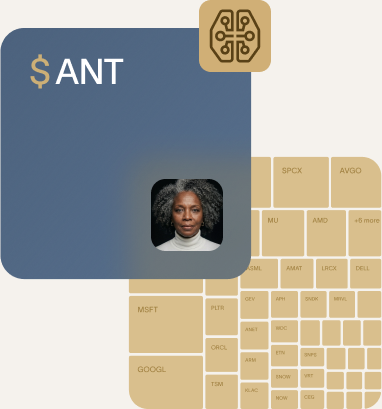
{{technocortex}}
In brief
- Technocortex is Cache's first thematic exchange fund, built for stockholders of companies across the AI economy.
- AI's growth depends on three layers of business: platforms and applications, the chips and systems that run them, and the power and physical infrastructure behind them. Technocortex is designed to hold companies across all three.
- New AI companies can be added as they go public, and the fund may also add select private companies over time.
- It's designed to reduce single-company risk. AI theme risk remains, and the fund can fall sharply when AI stocks fall together. (Bedrock, UNIX, and Mosaic may better suit those interested in broader-market diversification.)
- Reservations are open now, ahead of the first scheduled close on January 15, 2027. Space for each stock is limited. It's open to qualified purchasers with a $100,000 minimum.
Bullish on AI, but overexposed to one company?
Concentrated stock positions are the result of being early: shares earned helping build these companies, or bought before the rest of the market caught on. Today, those positions tie a belief about AI to the fortunes of one company.
Those are two different investment decisions. You can be right that AI is a monumental shift and still be wrong about which company leads it, or about what that company’s stock will be worth.
We believe that the internet is the closest precedent. On March 27, 2000, Cisco, whose networking equipment was the backbone of the internet buildout, briefly became the world's most valuable public company. Although the internet went on to reshape nearly every industry, Cisco's stock didn't set a new closing high until December 10, 2025.²
Believing in AI shouldn’t require counting on the one company you hold today to lead it years from now.
A dynamic industry where winners keep changing
In each of the past four years, a different sector has carried the AI trade, and each shift put a different kind of company in the spotlight.
- 2023: Chips. Application companies were spending 20% to 40% of their revenue on inference and fine-tuning, and money poured into chips and cloud capacity.³
- 2024: Applications. Sequoia asked where $600 billion a year in AI revenue would come from,⁴ and companies started paying to put AI to work: OpenAI's annualized revenue tripled to $6 billion,⁵ and Palantir's stock more than quadrupled.⁶
- 2025: Power and storage. Data-center electricity use rose 17%, against about 3% for global electricity demand, as grid connections and power equipment became harder to get.⁷ Storage makers Western Digital and Seagate saw their stocks more than triple.⁶
- 2026: Memory. Micron's revenue more than tripled in its fiscal year ended September 2026, and it said most of its 2027 high-bandwidth memory supply was already under contract.⁸
Meanwhile, the revenue question has started to get answers. Meta said in October 2025 that revenue running through its AI-powered ad tools had passed a $60 billion annual run rate.⁹ OpenAI says its annualized revenue run rate grew from $2 billion in 2023 to more than $20 billion in 2025.⁵ Anthropic's revenue grew from $386 million in 2024 to $4.6 billion in 2025, then reached $16.3 billion in the first half of 2026 alone.¹⁰
We don't know where the next constraint will be, or which companies it will reward. It may come from a kind of business that barely exists today. And winners are rare: from 1999 to 2023, 83% of S&P 500 tech stocks trailed the average stock in their own sector.¹¹ So Technocortex is designed to own the AI economy as it grows, across all three of its layers (explained below).
Some of those businesses remain private for years. The median tech company that went public in 2025 was 12 years old, against 8 years old for listings from 1980 to 2025.¹² Technocortex can hold shares of select private AI companies before they go public. Private shares are harder to value and transfer, and company restrictions can still apply.
What Technocortex will hold
Technocortex follows a written mandate, set out in its offering documents. It's designed to hold companies across three layers:
- Platforms and applications that sell AI to businesses and consumers
- Compute and systems that run it, including chips, memory, networking and chipmaking equipment
- Power and physical infrastructure that data centers depend on, such as generation and grid equipment
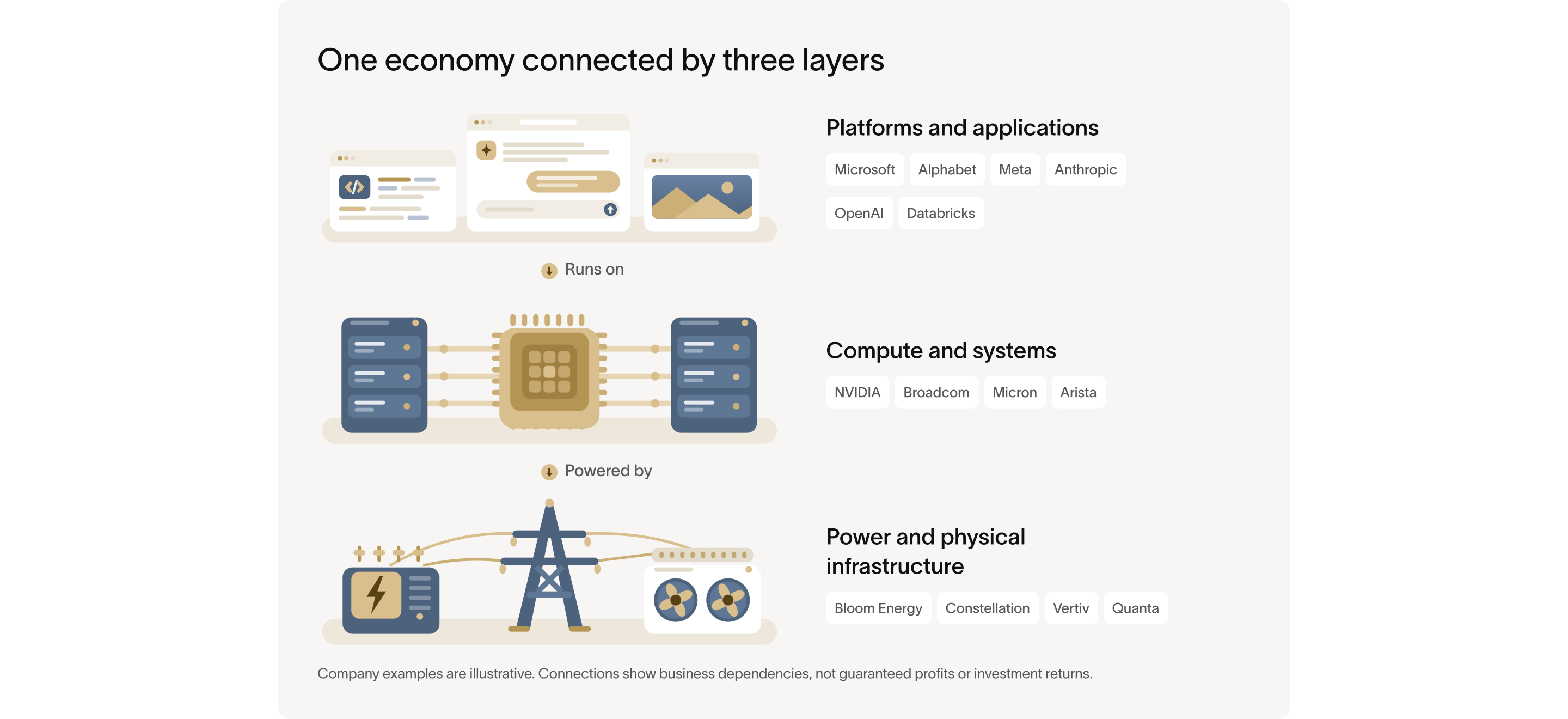
Weights are guided by market capitalization within each layer, scaled down so the largest companies carry less than they would in a pure market-cap index. The fund stops accepting a company's shares once that company reaches 15% of the fund.
Technocortex can hold AI companies listed on any US exchange, and non-US companies like TSMC and ASML through their US-listed shares. The mandate also lets the fund leave out companies outside the AI economy. Today's largest AI companies are also among the market's largest stocks, so at times the fund may move much like broad technology funds.
There's no industry-standard definition of an AI company, and the label is easy to adopt. Our investment team decides which companies qualify and documents each decision, looking for a real role in the AI economy and evidence of it in revenue or signed contracts. That turns up names many people don't think of as AI companies.
Bloom Energy sold onsite fuel-cell power to businesses such as hospitals and retailers for years before the rise of AI. In April 2026, it signed an agreement with Oracle for up to 2.8 gigawatts to support Oracle’s AI and cloud computing buildout,¹³ and in November NTT DATA agreed to 900 megawatts to support its growing data-center capacity and AI infrastructure needs.¹⁴
Some of the next AI leaders may still be private. Technocortex can add qualifying companies after they list. Anthropic, which begins trading on Nasdaq on November 19, is expected to be eligible from the first close. Over time, the fund may also add select private AI companies, up to 10% of the fund combined.
{{black-diversify}}
Who can invest
Technocortex is open to qualified purchasers (generally, individuals with at least $5 million in investments) who hold shares of a company that meets its mandate. Like Cache's other exchange funds, it's a long-term commitment: you'd generally hold for seven years to receive a diversified basket.
For broader diversification, Cache's Bedrock exchange fund is benchmarked to the S&P 500. Cache's UNIX and Mosaic exchange funds are benchmarked to the Nasdaq-100 and the S&P 500 Growth index.
Where the thesis could be wrong
Conviction isn't certainty. Railroads and the internet both changed the world, and both went through booms that funded good and bad ideas alike, then corrections that many of those companies didn't survive. AI may follow the same path, and a company can change the world and still disappoint investors.
Platforms, compute and power are different businesses, but they rise and fall on the same spending. If AI customers can't earn enough to justify the buildout, weakness can travel through every layer at once. A basket can reduce dependence on one company losing a key customer or going through a leadership change. It can't remove the shared dependence on AI spending and investor expectations, and Technocortex doesn't hedge that risk.
Timing is part of it too: we're launching after a long rally in AI stocks. Rallies can end or reverse without warning. If AI stocks fall, the value of the fund would fall with them.
Other risks:
- Weights are guided by market capitalization, scaled down for the largest names. That still tilts the fund toward the biggest companies and toward whatever the market values most at the time, and any holding can be overpriced or underpriced.
- The fund is built from the shares investors contribute, so its actual mix can drift from its target weights, sometimes for long periods.
- Chipmakers, especially memory makers, are cyclical, and compute is expected to be one of the fund's largest layers.
- Many of the companies likely to be among the largest holdings aren't pure AI companies. Apple's devices and Amazon's retail business can drive their results more than AI does.
- Export controls and trade policy can hit the whole theme at once. Non-US holdings add currency and foreign-tax effects, and private shares, if and when the fund adds them, are harder to value and transfer.
- Our investment team decides which companies qualify. Those are judgment calls: you may not agree with every one, and some may prove wrong.
We don't know which company will lead AI in the decade ahead, and we're wary of anyone who claims to. We do believe AI’s impact will be far larger than it is today. Technocortex is how you can choose to act on both beliefs.
How to reserve
Reservations are open now, ahead of the first scheduled close on January 15, 2027. The minimum contribution is $100,000, and the process works like Cache's other exchange funds. Capacity is limited for each stock, so some contributions may receive a partial allocation or none.
{{technocortex}}
The Cache Exchange Fund can help.

Make better decisions for managing your large stock positions.
Sign up to receive all our insights and data.